Published
08.10.2026
At high altitude, physical fitness alone is not enough. Professional athletes competing above 2,500 metres must also react quickly and make clear-headed decisions under demanding conditions. This is the focus of the Hyperhypoxikon project. Its name combines the concepts of hyperoxia, hypoxia and cognition – referring to supplemental oxygen, oxygen deprivation and cognitive performance. The project investigates how cold temperatures and high altitude affect both physical performance and cognitive multitasking abilities. It also examines whether supplemental oxygen can improve performance during simulated ski races, as well as reaction time in response to visual stimuli.
An innovative ski simulator
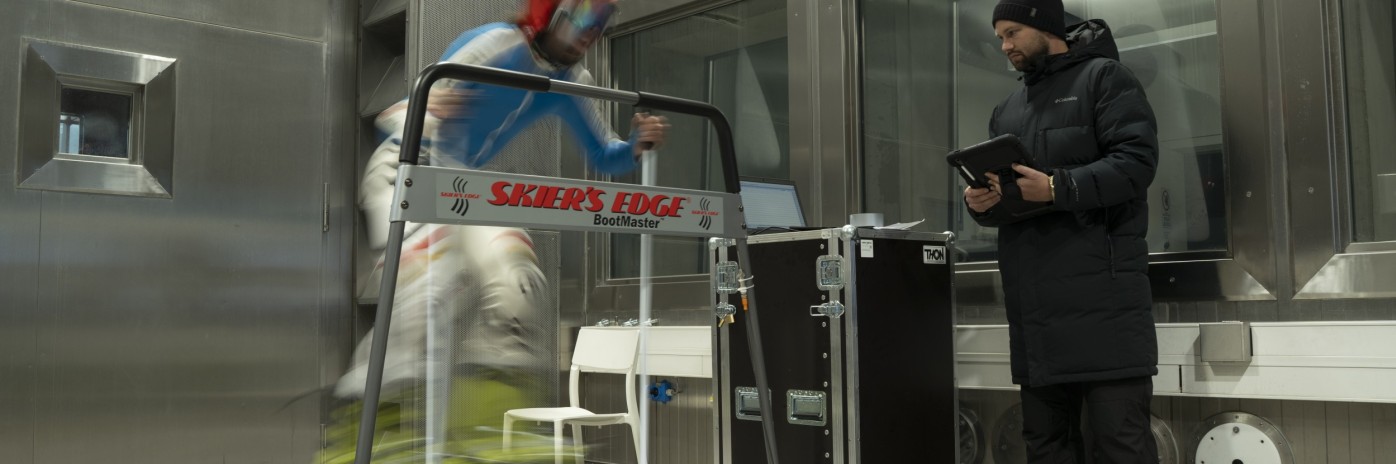
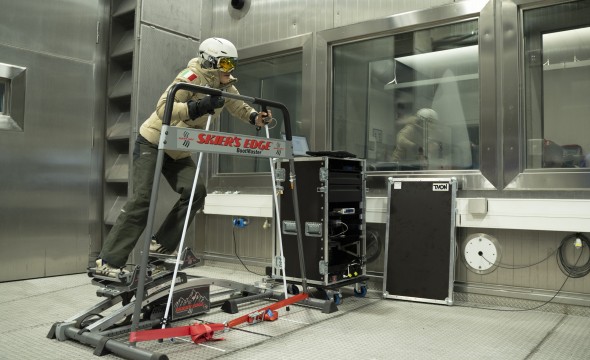
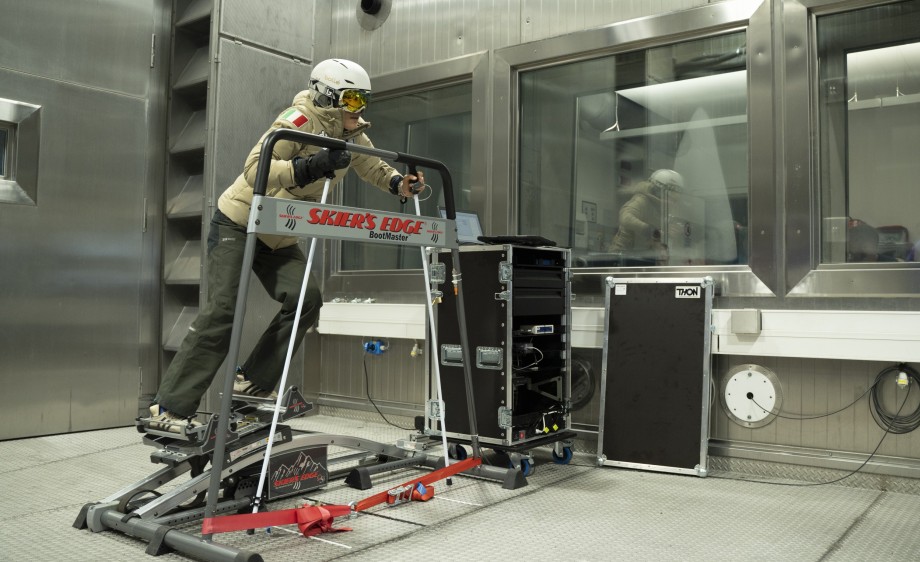
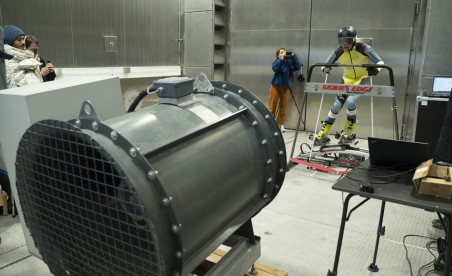
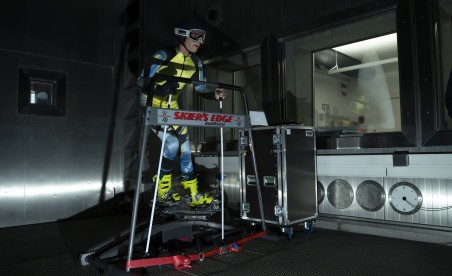
To support the research, the project team has developed a prototype multi-sensor ski simulator which allows realistic skiing movement sequences while providing highly accurate performance data. Test participants complete simulated slalom runs and respond to visual stimuli, while researchers analyse their movement patterns, muscle activity, coordination and reaction times. Unlike previous studies, Hyperhypoxikon does not focus solely on static exertion but also examines performance during active, dynamic movement.
Teamwork with a practical focus
The project brings together Eurac Research, Melittaklinik and the Dresden University of Technology (TU Dresden). Eurac Research contributes its expertise in high-altitude research and climate simulation at the extreme climate simulation centre terraXcube, while Melittaklinik provides medical expertise and an application-oriented perspective. TU Dresden supports the team in the technical development of the ski simulator.
Close collaboration between research, medicine and engineering is a key element of the project. "Working with Melittaklinik and TU Dresden through the Fusion Grant initiative has been an important step for us," says Professor Nikolaus Netzer, Senior Researcher at the Institute of Mountain Emergency Medicine at Eurac Research. "It allows us to productively combine medical research, technological development and practical application."
From prototype to market
The first prototype is already delivering promising results, although several technical refinements are still required: the interaction between movement tracking and the measurement systems needs to be refined, while training scenarios require further development. Video elements and variable speeds are also set to play a bigger role in the future. The ultimate goal is to release a licensed product onto the market, with potential customers for the ski simulator including high-performance centres, ski clubs and specialist ski schools, professional athletes as well as rehabilitation facilities.
Hyperhypoxikon is one of ten projects selected for the third edition of Fusion Grant, an initiative of the Stiftung Südtiroler Sparkasse (the South Tyrolean Savings Bank Foundation) in cooperation with NOI Techpark, the South Tyrolean Business Association and the business network Rete Economia-Wirtschaftsnetz. The initiative actively promotes collaboration between South Tyrolean companies and research institutions, and offers researchers under the age of 40 a pathway into practice-oriented projects.