Published
06.06.2024
How do you transport construction materials and other heavy goods across rough terrain while also reducing noise and emissions? AFusion Grant project has the answers.
Helicopters are generally used for high-altitude construction sites, cable car construction and high-tension power line maintenance due to their ability to transport heavy materials quickly and easily over rough terrain. However, helicopter operations are expensive, noisy and far from ecologically friendly due to their emissions. For brothers Moritz and Matthias Moroder, drones are an interesting alternative as they consume less energy, generate fewer emissions and are silent.
Their company, FlyingBasket, has specialised in cargo drones since 2015. “Our drones can transport goods weighing up to 100 kilos in a cost-effective and ecological manner, and in the future we want to transport heavier loads over greater distances too,” explains CEO Moritz Moroder. To achieve this, the two brothers teamed up with the Free University of Bolzano and applied to Fusion Grant, a call for proposals organised by Fondazione Cassa di Risparmio di Bolzano in collaboration with NOI Techpark, Economia Alto Adige and Rete Economia.
RESEARCH IN COMPANY
“There’s potential for improvement, particularly in the control algorithm. Along with the Field Robotics Lab of the Free University of Bolzano at NOI Techpark, we implemented a new algorithm that controls the drone’s eight rotors. This algorithm enables more energy-efficient flight manoeuvres and improved flight characteristics,” explains Moroder.
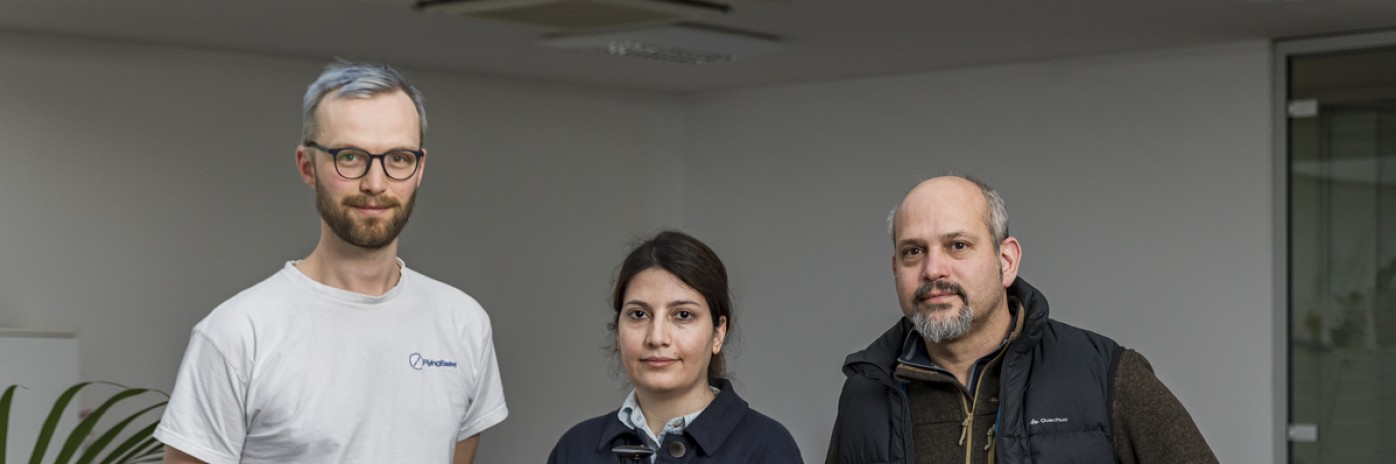
Sometimes new discoveries emerge through trial and error. “In reality, things don’t always work exactly as they do on paper or in a simulation, but setbacks can generate new approaches to solutions,” says Parvin Mahmoudabadi, a researcher involved in the project. Supporting such young postdoctoral researchers is one of the goals of Fusion Grant. Born in Iran, Mahmoudabadi came to South Tyrol specifically for this project and conducted research in company for unibz.
INCREASINGLY AUTONOMOUS DRONES
“New, promising technologies must often overcome a kind of ‘valley of death’ before they are adopted in practice. Promoting cooperation between industry and science helps bridge the gap between research and application,” stresses Karl Dietrich von Ellenrieder, the project’s scientific coordinatorand professor of automation at the Free University of Bolzano. Moritz Moroder shares this view and explains: “Collaborating with the university has brought us closer to research, meaning we can integrate the latest discoveries more quickly into our products and bring them to market.”
In future, FlyingBasket drones will mainly fly autonomously, enabling pilots to monitor multiple aircraft simultaneously. The long-term goal is to create fully autonomous drones that always cover the same route, for example between two mail sorting centres.