Published
30.06.2021
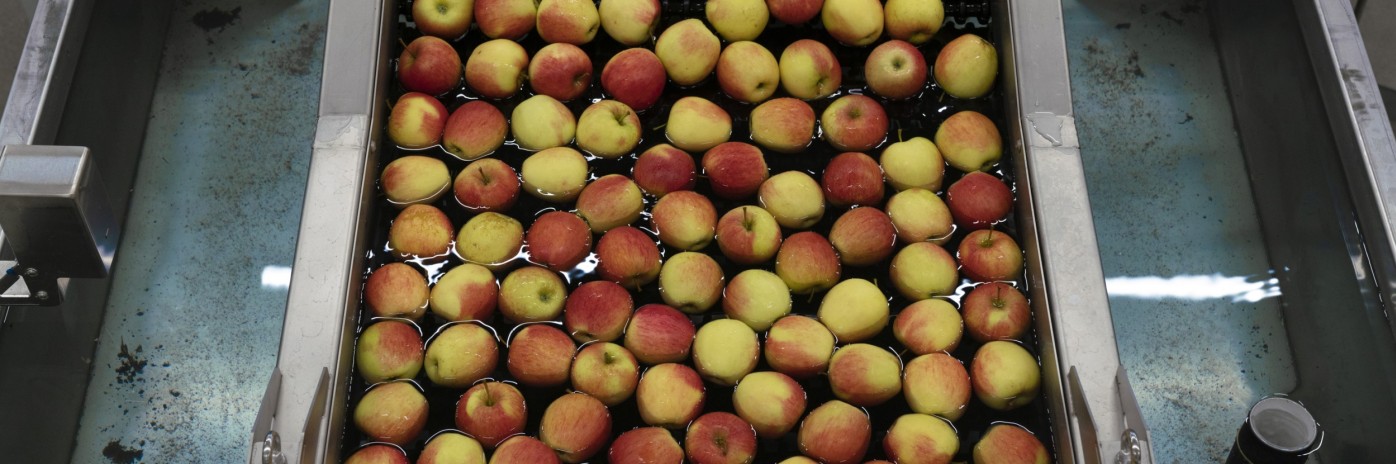
It’s no secret that South Tyrol is a land of apples. Around 950,000 tonnes are harvested each year. However, not everyone knows what happens before these apples are sold, and in particular, what happens during sorting and washing. This is where HSE Engineering & Construction comes in. They have teamed up withour Tech Transfer Green team and developed an innovative system to filter, purify and recover process water. Large quantities of water and very high operating costs are usually necessary, but the HSE system, which is already in use at several cooperatives (including Mivor in Laces), uses a combination of ozone and mechanical filtration. “This saves energy, maintenance costs and large quantities of water, while also avoiding harmful residues and chemicals,” explains Christian Laureanti, engineer, director and owner of HSE.
But let’s go back a step. Water from apple sorting contains large amounts of organic matter, such as sugar and yeast, as well as and microorganisms, such as spores and bacteria. These quickly make the water cloudy, meaning it must be replaced at least once a week. Ozone, on the other hand, is an excellent disinfectant, and when this gas decomposes spontaneously, it produces oxygen, a completely harmless element. This makes it compatible with organic processes. “The idea was conceived in 2015 in collaboration with COOP ROEN in Caldaro, but it’s only recently, and with the support of NOI Techpark, that we’ve been able to turn the project into something concrete. To be able to execute the project, we organised our ideas, data, and the pilot experiments we had conducted over the years,” confirms Laureanti.
The system is characterised by three elements. A cloth filter automatically performs self-cleaning. A contact reactor ensures maximum dissolution of ozone in water, and an ozone generator produces ozone continuously and in a controlled manner from compressed air. “Getting funding for a feasibility study and support through the various stages of development from NOI Techpark was essential. We were able to create a real system and standardise the application, as well as reduce costs and assembly times. Most importantly, however, we ensured more effective and efficient recovery and treatment of process water,” concludes Laureanti.