Published
06.05.2024
You need more than just an initial idea to be a technical leader in your market segment. You must continuously work on optimising and developing so that you remain the customer’s first choice. That’s why our only goal is continuous innovation. The most successful businesses in our region are leaders in quality or innovation (or both) in their respective markets. This is true despite our area not being ideal for alternative strategies, such as cost leadership, which can give you a competitive advantage by offering the lowest operating costs.
Nevertheless, Val Pusteria (and indeed all of South Tyrol) is a highly competitive technological and industrial district for the global automotive industry. There are many excellent businesses in this sector. Alongside the eight network partners — Alupress, Autotest, GKN Driveline, GKN Sinter Metals, Tratter Engineering, Intercable, Intercable Automotive Solutions and Abuscom — there are other outstanding firms, including Alpitronic, Röchling, Iveco DV and AL-KO Kober, to name a few. For each of these businesses, standing still and failing to explore new opportunities would be fatal. The same goes for our regional economic system. So yes, we’re in a good position, but we must continue to develop.
AES was a strong supporter of the second NOI Techpark in Brunico, which opened in the spring of 2023. Why?
Because we need to explore new dimensions and broaden the frontiers of innovation and business development. Exploring new ways of collaborating enables us to handle momentous challenges together rather than alone. It allows us to join forces, share costs and risks, and work faster with a greater probability of success. No matter how big or successful a company is, it will always benefit from collaborating with others.
So why isn’t NOI Bolzano enough?
An innovative ecosystem requires the involvement of businesses, research institutes, the local community, schools and young people. That’s why the decision was made to establish NOI Techpark not only in Bolzano’s innovation district, but also in Val Pusteria, an important industrial and economic district, so that we could connect more closely with and integrate better into the region.
What major challenges are currently faced by suppliers in the automotive industry, and how must they respond to future developments?
The most significant challenges for automotive suppliers relate to major issues affecting the entire industry: the twin transitions (sustainable and digital) and a shortage of skilled workers. These challenges are particularly serious in the automotive industry, where automation levels and ambitious digital solutions mean a lack of skilled workers has an extremely significant impact. The sustainability challenge, on the other hand, affects the entire value creation chain, from the use of recycled and low-impact materials to the development of low-emission processes. There are many more challenges, but we consider the three mentioned here to be the easiest to face together.
How can NOI help in this context?
We see NOI as the ideal, neutral ecosystem in which to create and develop this new dimension of cross-company collaboration. We have already developed many successful initiatives in close collaboration, from the initial creation and development of our network to a series of events that promote contact between industry, academia, and the community.
Like the International Mechatronics Forum at NOI Brunico in September 2023, for example, where the latest R&D results from the automotive, mechanical engineering, agricultural engineering and IT industries were presented?
Exactly. The International Mechatronics Forum is one example, as are the IN MOTION festivals launched in 2023. There have also been job fairs, professional development for staff and plenty of networking initiatives. In recent months, we have created numerous working groups composed of employees from various companies, which have primarily focused on the aforementioned challenges: digitalisation, sustainability, carbon footprint, human resources and recruitment. NOI has played an active role in each of these groups. Progress has been much faster by bringing people together and providing stimuli and starting points for reflection. We see NOI as a gateway and a dedicated partner who shares our vision of creating added value for our economic system and for South Tyrol.
According to the latest data, there are more than 800 companies and over 16,000 employees working in the automotive and automation industries in South Tyrol. How strong is collaboration in this sector?
I believe that this historical moment will teach many businesses that cooperation is not just an opportunity, but often a necessity. Year on year, companies are becoming more willing and open to this. Historically speaking, the automotive industry has been closed off. In fact, I would say it is almost introverted. Each company has always focused on internal matters and often viewed other firms as potential rivals. This was the case before, but now we are all united in our need to tackle and overcome the huge challenges I have spoken about.
With AES, and with a major automotive industry supplier like Intercable, you already have experience of working together on joint innovation projects. What is the main benefit for members?
One of the main advantages is the focus. Often, individual companies aren’t able to invest sufficient attention (or the necessary resources) in issues that they do not consider urgent. By joining forces, however, it becomes possible to multiply our efforts and achieve results that would probably be unattainable on our own.
We’ve spoken about companies partnering up. But how strong is collaboration with research institutes and the academic world?
For projects involving a certain level of complexity and technical innovation, contact with the world of research and academia is crucial. This is the main reason why we funded an associate professor position in sustainable manufacturing at the Faculty of Engineering. This position was recently awarded to Professor Erwin Rauch, who hails from South Tyrol and boasts an impressive academic and industrial background, not to mention excellent scientific ratings.
We expect this partnership and local presence to contribute significantly to the creation of an innovation community involving all stakeholders and the local community. It will also bring the community closer to the world of research and technology, particularly in the fields of future mobility and sustainable manufacturing.
NOI Techpark Brunico is set to break new ground, particularly in the field of sustainable mobility. NOI Techpark Bolzano already carries out research and development in various technological sectors, especially in automotive automation. What benefits has this brought to the automotive cluster?
There are three main concepts: 1. Access to the best international partners in terms of research, innovation and training. 2. Consulting on how to access external research funding, such as national and European funding. 3. Knowledge transfer and continuous opportunities to share ideas and connect with companies of various sizes.
In summary, what would you like to be mentioned again in a speech celebrating the first anniversary of NOI Techpark Brunico?
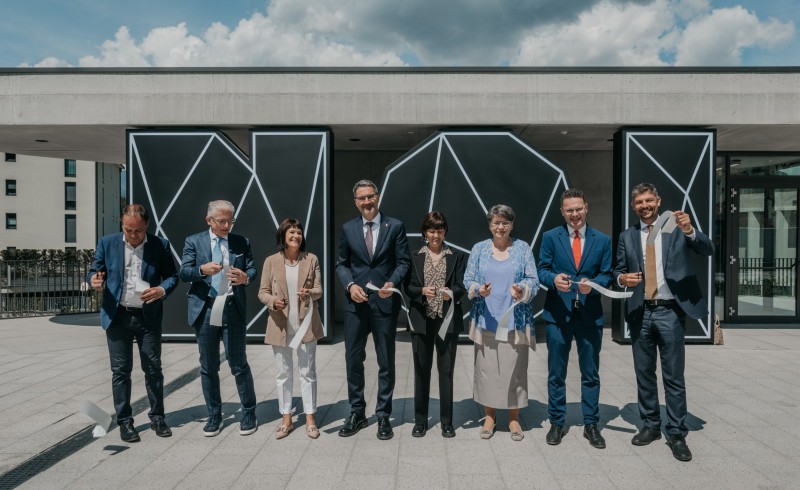
Firstly, this first year has flown by. Looking back over the last 12 months, a lot has happened in terms of events and activity. We have held over 15 events, including festivals and meet-ups, such as our IN MOTION Festival, which is dedicated to sustainable technology and innovation and showcases emerging talent. There was also the International Mechatronics Forum and the Thrive community event, which was supported by our network and involved companies from outside our network, as well as four schools and universities. Over a thousand people participated in or visited these events. It was also the year that we moved to our new home, and the year in which several research projects led by Professor Rauch quickly got off the ground. His research team currently comprises 12 researchers working on international and inter-company projects. I expect there will be plenty of collective projects and initiatives over the next 12 months, too.
Climate-resilient farming
How can South Tyrol’s agriculture adapt to climate change? This is the challenge that KONVERTO and Eurac Research are addressing as part of their joint Fusion Grant project.
Viticulture and apple farming are among the region’s main agricultural activities, yet they are particularly vulnerable to changes in climate and environmental conditions. Temperature and rainfall directly impact plant health, product quality, and harvest. The dilemma? Until now, there have been no robust adaptation strategies to combat climate change. Farmers and policymakers are often left to fend for themselves.
Bolzano-based IT company KONVERTO and the Center for Sensing Solutions at Eurac Research aim to bridge this gap with their joint project ClimSmart. The project is part of the Fusion Grant call for proposals that supports researchers under the age of 40 and builds new collaborations between research organisations and businesses. Fusion Grant is promoted by Fondazione Cassa di Risparmio di Bolzano and NOI Techpark (in partnership with Südtiroler Wirtschaftsring-Economia Alto Adige and Rete Economia-Wirtschaftsnetz).
The study made use of the latest high-resolution climate data and innovative analysis methods. Using these, the two partners were able to highlight the impact of climate change on apple orchards and vineyards and identify soil-specific adaptation measures. They then added this information to KULTIVAS, an interactive decision-making platform for agriculture developed by KONVERTO. KULTIVAS uses almost 790,000 data points across South Tyrol to create precise maps and make forecasts.
Landscape ecologist Lukas Egarter Vigl from Eurac Research states, “We gathered a large quantity of climate data and used this to calculate precise climate scenarios. “We want to understand how a particular agricultural area will develop over the next 20, 50 or even 80 years in relation to changes in atmospheric and meteorological conditions, and what effect these will have on various fruit crops.” This information will contribute to intelligent decision-making. “Fruit cooperatives can use this data to evaluate which variety would be most advantageous in a certain location or whether water shortages are more likely,” explains the researcher.
Johannes Erschbamer, head of KULTIVAS at KONVERTO, is convinced of the project’s benefits. “All the information from the ClimSmart project is stored and analysed on our central data platform. This provides new insights into the effects of climate change and will contribute to the development of more competitive, sustainable and climate-resilient agriculture.”