Published
08.05.2024
“Trees are effective at regulating the climate and they become more effective each year,” states Helga Salchegger, the project’s scientific coordinator and head of the Department of Floriculture and Landscaping at Laimburg Research Centre. “That’s why one of our goals with Talking Trees was to emphasise the importance of trees in our cities.” We often don’t pay attention to trees, but they play a key role in the urban climate, especially in summer. They perform fundamental tasks such as providing shade, filtering CO2 and particulate matter, purifying the air and retaining rainwater. However, the conditions in which trees carry out their work are often bleak, with insufficient space for roots and canopies and a risk of drought in summer.
What exactly do the trees in our cities do? How do they behave and how can we help them do their work? Researchers from Laimburg Research Centre have studied these aspects together with the private companies R3GIS and CISMA at NOI Techpark. Their project is part of the Fusion Grant call for proposals organised by Fondazione Cassa di Risparmio di Bolzano in collaboration with NOI Techpark, Economia Alto Adige and Rete Economia.
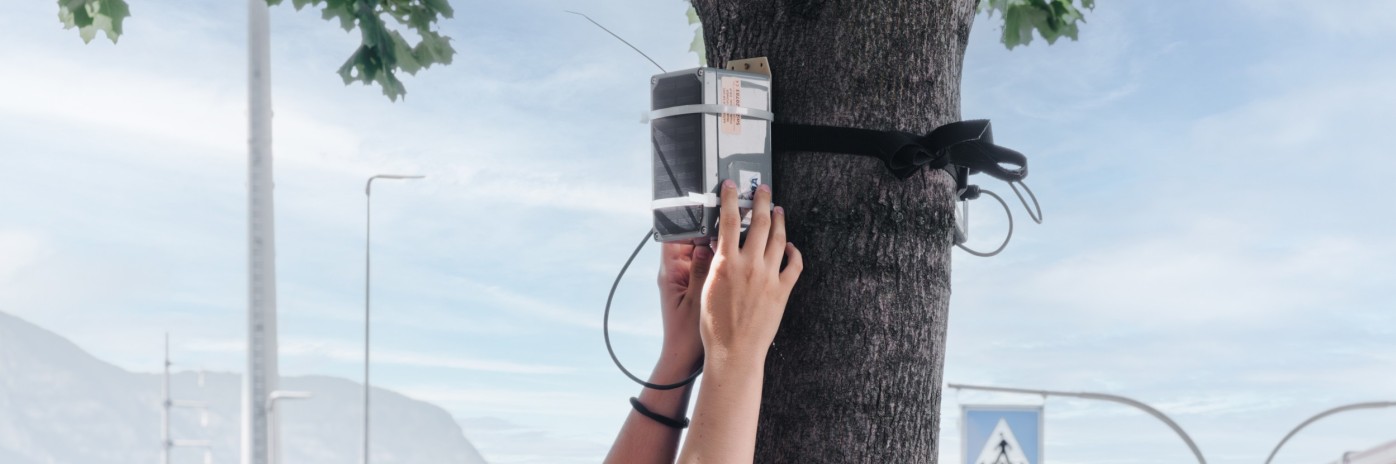
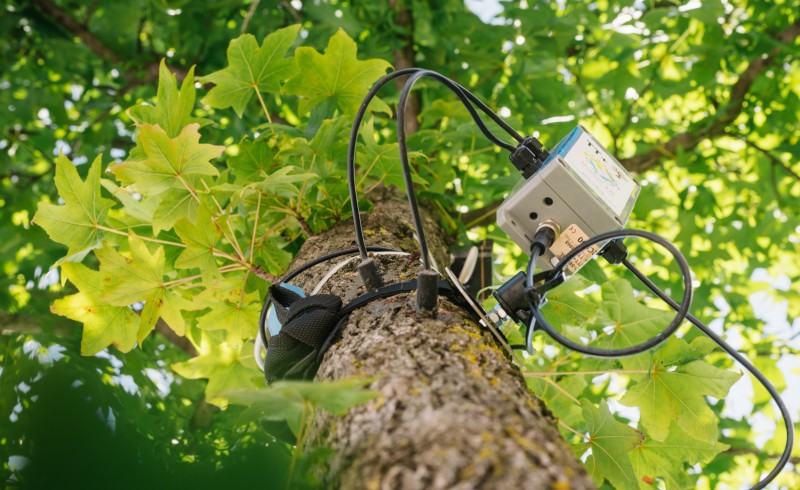
As part of the Talking Trees project, sensors were placed on trees to monitor them and calculate the benefits they bring to the urban climate. These sensors provide a constant source of information on bark water content, sap flow, light transmission, growth and tree lean. They also measure atmospheric humidity and environmental temperature.
This data is then compared with soil and foliage data. The project also analysed which tree species provide the most shade, filter the most dust and release the most moisture through their leaves during the growing season.
In addition, the project aimed to determine which sensors are most suitable for specific applications, providing the greatest possible amount of information while avoiding excessive maintenance. Project partner CISMA is responsible for the sensors, contributing its experience in installing and operating measurement tools for
air quality, meteorological parameters and hydrological parameters, as well as its expertise in data analysis.
The other project partner is R3GIS. Their GreenSpaces platform enables cities and businesses to manage green spaces efficiently and sustainably. This includes the Interreg project VerdeVale for the use of urban green spaces, for which Bolzano is the pilot city. The South Tyrolean capital has around 70,000 shrubs and 12,800 trees in its public green spaces. The main goal of the Fusion Grant project Talking Trees is to support the health of these plants and improve the climate and quality of life in the city.
More information on the Fusion Grant call is available at fusiongrant.info.