Published
15.05.2024
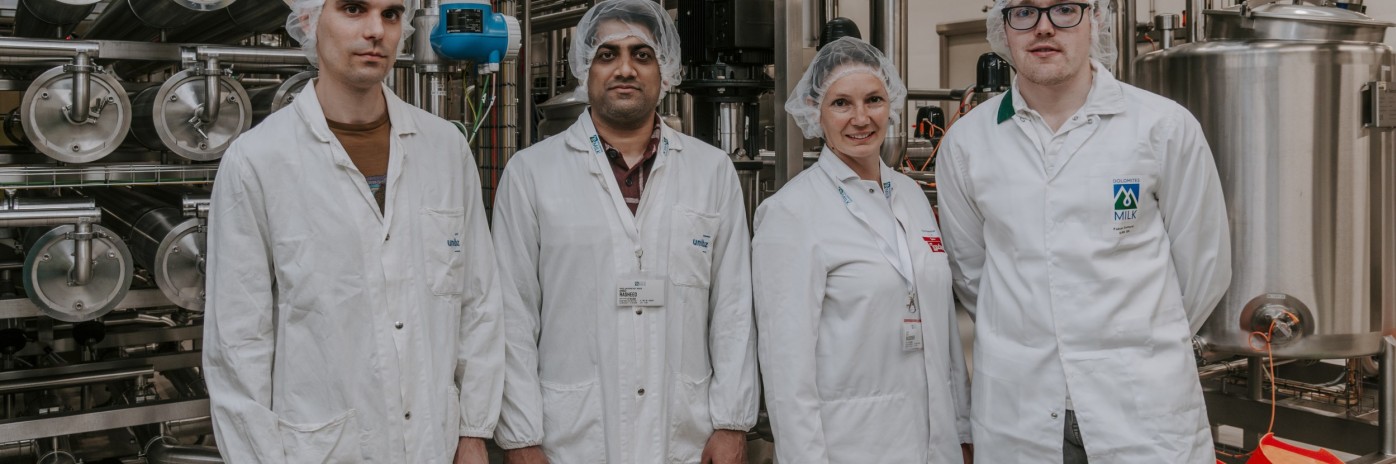
The family-run Loacker company has always focused on quality, using premium raw materials and sustainable production processes. Some of their hazelnuts come from the company’s fields in Tuscany, and their whey and skimmed milk powder are produced in-house at the Dolomites Milk plant in Vandoies, a joint venture with the Brimi dairy in Bressanone.
However, producing the powder from locally sourced South Tyrolean milk and whey requires a large amount of water. Each cleaning cycle of the production system uses several hundred litres, equalling over 50,000 cubic metres of water a year.
Collect data and save water
“We’re trying to understand how sensors can help us make wastewater management more efficient. The project with the Free University of Bozen-Bolzano contributes to a two-fold objective: firstly, it helps us become more sustainable, as the more we monitor water usage, the less we use. Secondly, it brings us closer to our goal of becoming a smart factory. Accessing important data online enables us to improve automatic production monitoring,” explains Petra Massoner, head of applied research at Loacker.
The project monitors both Loacker’s fresh water and wastewater. “Current consumption is based mainly on empirical values and offline laboratory measurements. Our goal is to use sensors to measure values online and in real time. We aim to potentially save 5–10%, which would make a significant difference over the course of a year”, states Massoner.
The study is part of the Fusion Grant call for proposals, which supports researchers under the age of 40 and encourages close collaboration between research centres and local companies. The call is organised by Fondazione Cassa di Risparmio di Bolzano in collaboration with NOI Techpark, Südtiroler Wirtschaftsring-Economia Alto Adige and Rete Economia-Wirtschaftsnetz.
Research in company
The pH level, nitrate content and chemical oxygen demand (COD) of wastewater must also be monitored. COD indicates how many organic compounds the water contains. The lower this value, the better. The initial aim of the project was to identify the most suitable sensors for these measurements. “Dolomites Milk systems are cleaned with hot water, but only a few sensors are designed for temperatures above 50°C,” explains Luisa Petti, professor at the Faculty of Engineering at unibz, scientific coordinator of the project and head of the Sensor System Technology Lab at NOI Techpark.
The collaboration with the company is particularly interesting for researchers. “It’s important that we understand what is needed in an industrial application, and this applied research, in turn, helps us with our basic research,” Petti highlights.
The sensors tested as part of the Fusion Grant project are interesting for other applications too. For example, the professor notes how they could provide valuable, real-time data on water quality in aquaponic systems, which involve farming fish and plants together in a closed-loop system that uses the water the fish are farmed in to provide nutrients to the plants. Petti explains that there has already been some demand. Eco Center, which deals with wastewater treatment and waste disposal in South Tyrol, has expressed interest in using the sensors not just in water, but also in soil and air, and sensors could also be used in greenhouses in the near future.
A win-win for everyone
Applied research with widespread benefits, therefore. However, according to the Free University of Bozen-Bolzano, there’s another important aspect. “Working with a brilliant researcher like Ahmed Rasheed, who came to South Tyrol for this project, adds value. Fusion Grant is very important for companies, for academia, and young researchers too,” she highlights.
More information on the Fusion Grant call is available at: fusiongrant.info.