Published
12.04.2021
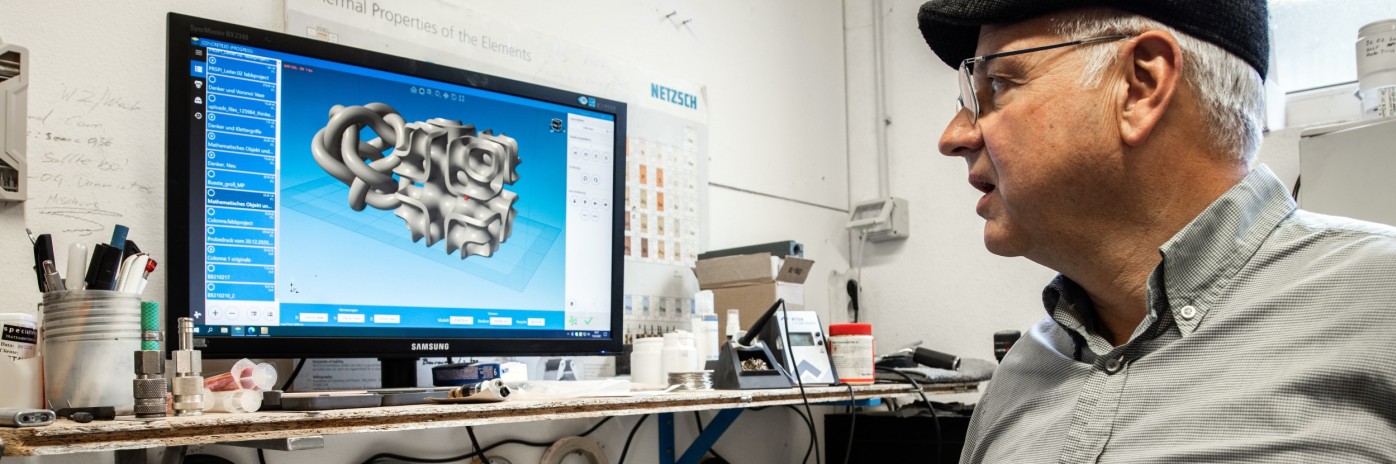
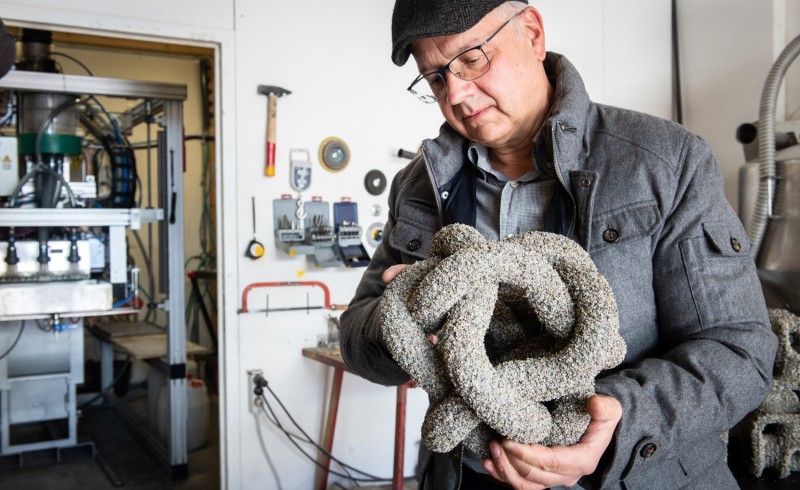
In an industrial warehouse in Val Sarentino, a printhead capable of printing 3D concrete objects of any shape from one of the most widely used construction materials of all time has been created for the first time anywhere in the world. Mr Wohlgemuth obtained the patent in early 2021, after an impressive ten years of research and development. This demonstrates not only his vision, but also his curiosity, courage, determination, and a healthy dose of Val Sarentino stubbornness. He also had the support of an extensive network of partners who helped him to implement his project.
But let’s go back a step. Kurt Wohlgemuth’s career teaches us a lot about the nature of innovation. For example, it shows how it’s possible to reinvent yourself constantly. The son of a blacksmith, he initially trained as a wrought iron metalworker. After working for a few years at a mechanical engineering firm in Germany, he returned to Val Sarentino and realised that there was decreasing demand for his trade in contemporary architecture. Consequently, he founded his company, Metall Concept, and started manufacturing decorative metal staircases. Initially, business was slow, so the entrepreneur developed catalogues showcasing his most exquisite wrought iron staircases to present to trade audiences at the Salone del Mobile furniture fair in Milan. This proved to be a brilliant idea. “The orders came flooding in!” he laughs.
However, his entrepreneurial spirit didn’t stop there. Even though his order book was full, he wanted to do more than build staircases. For eleven years, he focused on his vision of fully digitalising the construction of staircases, from planning to production. At the time, this was an extremely ambitious idea, given that 3D design was still in its infancy. Wohlgemuth managed to create a 1:10 prototype of a digitally designed staircase thanks to the support of Johannes Brunner, head of Tech Transfer Automotive and Automation at NOI Techpark. The two still work together to this day. Brunner became a leading partner for all activity, whether conducting materials and market research, networking with companies and universities, or developing and submitting applications for half a dozen R&D projects. Like the ambitious innovator from Val Sarentino, he too found that he had to reinvent his strategy. “Kurt often got to the point where we thought, ‘That’s it, we’ve done it.’ Then he wouldn’t be satisfied and we’d have to start again from scratch,” Brunner recalls.
To get close to his vision of 1:1 stair printing, Wohlgemuth first developed a patented system for creating prefabricated formwork for concrete stairs using a five-axis milling machine. This alone created a new and profitable line of business, as these precision machines could be used to process small batches of plastic components for renowned vehicle manufacturers. However, Wohlgemuth still wasn’t satisfied. After various intermediate stages, he teamed up with Progress, a concrete specialist based in Bressanone, and developed the first large-scale 3D printer for sorel cement. However, this material offers far fewer application possibilities than concrete, so Wohlgemuth continued his research. In 2021, he patented the world’s first 3D concrete printhead. Unlike conventional contour crafting, it does not require complex support structures, enabling the free printing of any three-dimensional shape or object by injecting liquid Portland cement into a bed of coarse-grained sand. This Selective Paste Intrusion (SPI) technology reduces CO₂ consumption in the production of concrete parts, as concrete is only used where required by the respective shape.
It is a success story that draws on the expertise of many different fields, because at every stage, and particularly after every setback, Wohlgemuth was supported by a network of partners that has grown over the years. The Department of Materials Engineering at the University of Trento provided crucial input into the creation of solar cement. The Technical University of Munich played a key role in developing the SPI technology, and BASF supplied the special superplasticiser that enables cement to be passed through the nozzles. As a project partner, Progress M&A not only provided funding, but also contributed the expertise of its highly qualified staff in mechanical engineering, computer science, and materials. National and international technology companies were involved in developing the printhead. Many of these partners regularly visited Val Sarentino to exchange ideas with the entrepreneur and learn from his discoveries. A copy of the printhead prototype developed in Val Sarentino is used at the Centre for Building Materials and Materials Testing at the Technical University of Munich, where test parts made of various materials are continuously printed and tested.
The spirit of the innovation culture that permeates NOI Techpark is all about cooperation, knowledge sharing and transfer. However, we also need entrepreneurs like Kurt Wohlgemuth, who are passionate about an idea and never stop believing in it. He is a craftsman who tried and tried again, made mistakes, changed direction, and ultimately achieved his goal of becoming a hi-tech entrepreneur. Kurt Wohlgemuth also acknowledges that another factor contributed to this challenging innovation process: “When a small artisan business invests a lot of money in an R&D project, at some point the whole thing has to work and there’s no going back.” As he has demonstrated, with the right partners, it's worth the risk.
Here you can find out more about this service.