Published
01.04.2023
By offering networking opportunities, collaborations and R&D consultancy services, NOI opens doors that would otherwise remain shut, particularly for small businesses. One such company is CPE, founded by physicist Markus Wenin.
Balancing scientific research with building a company might seem a mammoth task, especially when both challenges rest on the shoulders of one person. In this case, that person is Markus Wenin, a physicist from South Tyrol. After teaching theoretical physics in Graz and working at a research centre in Linz, Wenin’s entrepreneurial spirit began to grow. Having gained an increasing amount of expertise in simulating cable vibrations in cable cars and funiculars, he was keen to capitalise on this knowledge.
Wenin therefore took a huge step, came back to South Tyrol and set up the start-up CPE, an acronym for Computational Physics and Engineering. It was then that he realised what a huge step he’d taken. His aim to develop software to calculate and optimise cable car vibrations put him on a promising scientific path. However, he needed capital and research partners to achieve this. On top of that, how would he find the time for market research, customer acquisition, and all the other aspects of being an entrepreneur? He tackled these challenges alone, but they are now less significant. Here’s why.
Even in the start-up phase, Wenin was able to take advantage of the support that our services offer companies. PhD student Moritz Patreider, who recently joined CPE, contributed to the success of the business, as did Johannes Brunner, head of our Tech Transfer Automotive & Automation team. “We recognised the huge potential of the software Markus wanted to develop right from our initial meetings,” Brunner explains. His team quickly conducted a market analysis with Wenin, identified companies that would potentially be interested in this technology and supported the entrepreneur in applying for R&D funding from the Innovation and Technology Office of the Province of Bolzano. Once this funding was secured, development of the software could begin. Meanwhile, some interesting collaborations emerged, including with Doppelmayr, a global leader in the ropeway industry based in Vorarlberg, and with Maria Letizia Bertotti and Giovanni Modanese, mathematical physics professors from the Free University of Bozen-Bolzano (unibz).
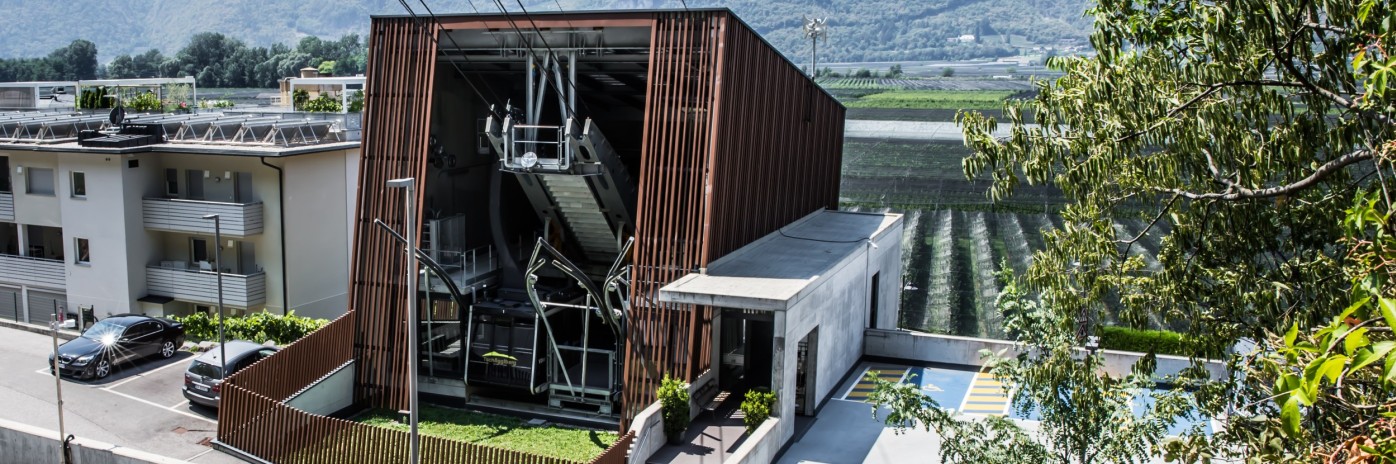
The tangible results of this collaboration can now be experienced in the Doppelmayr cable car from Postal to Verano. Using simulations based on mathematical physics models developed by Wenin and his unibz partners, the process of how a cable car crosses over a support could be optimised to reduce longitudinal sway. This has further increased ride comfort and is relevant far beyond Verano. The interdisciplinary team published an article in the peer-reviewed science journal “Sustainability” entitled “Validation of the Velocity Optimization for a Ropeway Passing over a Support”, in which they described how they reached this result.
Although the CPE company has been firmly established for some time, Markus Wenin regularly visits NOI Techpark. Another research project with an engineering firm is now underway at NOI. “In addition to concrete projects with the Tech Transfer Automotive & Automation team, a trust has been established over the years, generating a continuous flow of inspiration, ideas and contacts. There’s nothing more practical than a good theory,” says Markus Wenin.
“NOI Techpark acts as an R&D architect, supporting companies – our customers – in developing innovative products and identifying suitable partners who can produce them quickly and cost-effectively,” states Johannes Brunner.