Published
24.01.2023
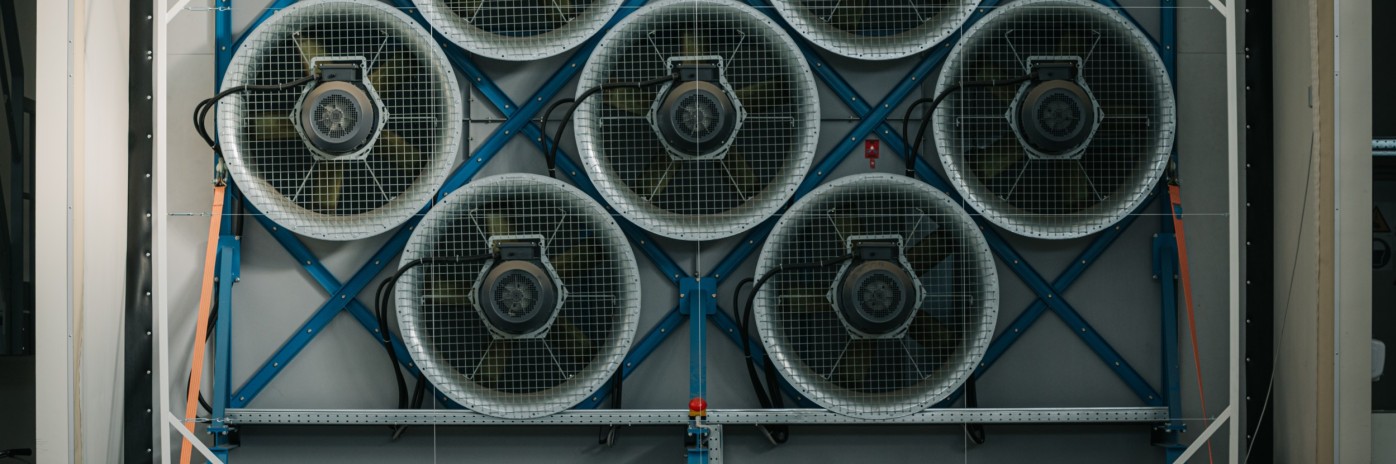
Switching racetracks with the apple orchards and vineyards of South Tyrol, the latest technology that has arrived at NOI Techpark is usually used to test racing cars. Critical thinking teaches us that innovation is everywhere: we just need to know how to identify, adapt and transform it. This is what happened with a wind tunnel at the Free University of Bozen-Bolzano’s Agroforestry Innovations Lab, a laboratory that develops new technologies for agricultural, environmental and forestry applications.
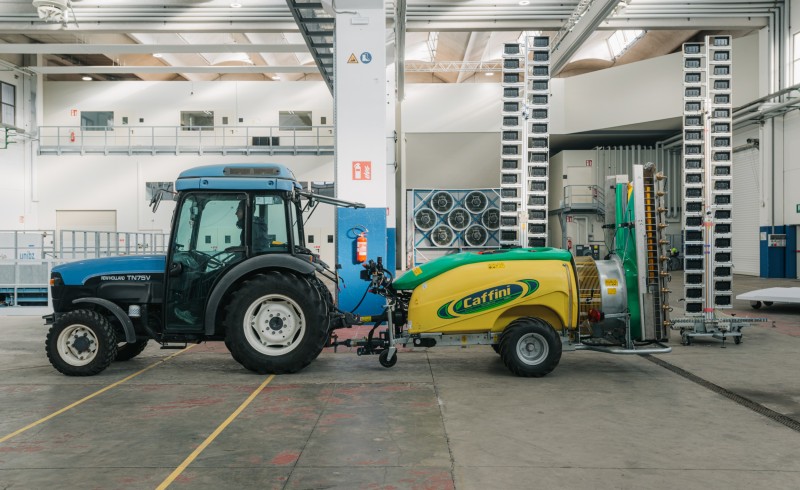
By adopting aerodynamic evaluation practices used for racing cars, the tunnel recreates a confined environment in which to assess the environmental sustainability of tractors and trailers, by measuring the dispersion of pesticides and other substances through an analysis of vertical and horizontal flow. The tunnel additionally certifies agricultural equipment. The project continues to attract attention not only from unibz researchers but also from industry associations and technical companies in the agricultural sector, including Caffini, a long-established manufacturer of crop protection machinery. Once companies have passed the laboratory tests at the Agroforestry Innovations Lab, they can obtain the EU certifications required to put their machinery into operation. The lab issues certifications that comply with Italian and German standards.
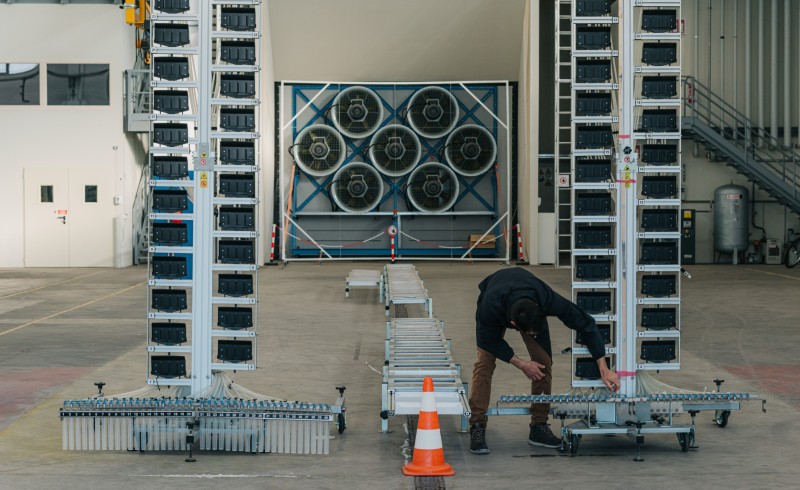
But let’s get back to dispersion. How does the NOI Techpark wind tunnel test agricultural machinery? The tests begin with the fans turned off. The partitions are then lowered, and from the bottom of the tunnel the fans are switched on to simulate the wind, operating at a maximum speed of 20 km per hour, which is ten times slower than the speed usually used for aerodynamic testing on racing cars. The tractor-operated sprayer then passes in front of the tunnel and sprays water through atomising nozzles to simulate pesticide delivery. Special instruments called patternators then measure product distribution and spray cloud. This analysis makes it possible to understand the extent of pesticide drift. If the level of drift is too high, the laboratory will instruct the company to reset the machine configuration.
In this way, agricultural machinery is tested in the field under real-life conditions. By assessing how these substances spread in the atmosphere, the design of the machinery can be optimised to limit pesticide drift and, consequently, pesticide pollution. A shadowgraph can be used to estimate the particles most likely to remain in the atmosphere by photographing samples containing tens of thousands of droplets. Special vertical patternators, which are designed to collect water at 10 cm vertical intervals, measure the quantity and distribution of pesticides at different heights. Alternatively, water-sensitive paper can be used to capture drops and evaluate the degree of spread.
The laboratory has a wide range of expertise within the field of agricultural engineering, including architectural and functional knowledge of the technologies used, as well as agronomic and digital skills for data collection. That’s not all, though. The laboratory led by Professor Fabrizio Mazzetto of unibz also conducts many other activities. These include developing technological solutions to automate agricultural and forestry processes, digitising management across agricultural and environmental companies, examining safety conditions of machinery on extreme slopes, and researching energy efficiency of agricultural machinery, including that powered by alternative fuels. After all, research and innovation can be applied to a multitude of fields, not least the certification of products and processes for technologies used in the agricultural and forestry sectors.
Here you can find out more about this service.