Published
13.12.2023
These safety and quality standards include CE marking and international standards, such as ISO certification. CE stands for 'Conformité Européenne' and certifies that a product meets EU health, safety, environmental and product performance requirements. The ISO (International Organisation for Standardisation) develops international standards for almost all economic and manufacturing sectors.
Testing laboratories play a vital role in measuring product characteristics and performance, and determining whether products comply with standards. These accredited laboratories are called CABs: Conformity Assessment Bodies. Each EU country has its own accreditation authority to monitor laboratories and approve their testing methods. Accredia, the Italian accreditation authority, has currently granted accreditation to 36 NOI Techpark tests conducted at the Eurac Research and Laimburg Research Centre laboratories.
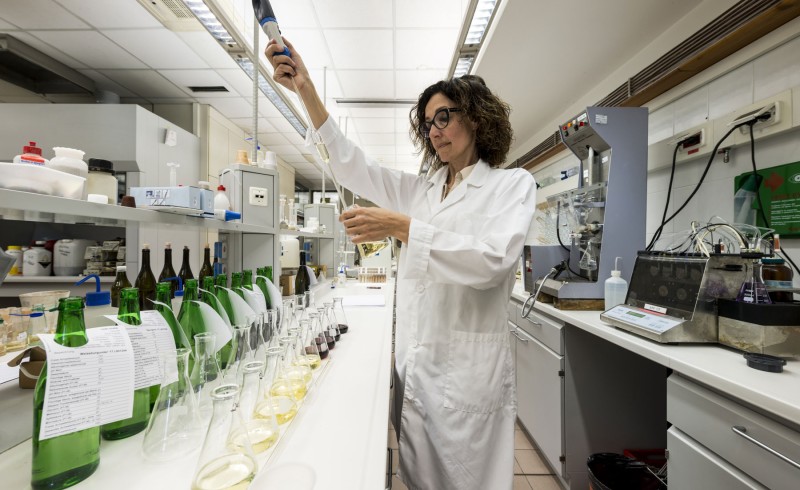
Many food products are subject to strict regulations regarding ingredients, residues, and contaminants. The Laimburg Research Centre's laboratories therefore test wine, apples, soil and fodder. Twenty years ago, the research centre’s first lab was granted Accredia accreditation, and fittingly for a wine-making region, this was the Laboratory for Wine and Beverages Analysis.
“Detailed analysis of wine and must is essential for quality control of the winemaking process in a cellar. Important parameters include total acidity, residual sugar, and alcohol content. The Laboratory for Wine and Beverages Analysis conducts physical and chemical analyses of grape must, wine, fruit juices, and distilled spirits for research purposes, as well as providing a service to private clients,” explains Andreas Putti, the Laimburg Research Centre’s contact for accredited laboratories.
Twenty-six accredited tests are currently available to companies at the four Laimburg Research Centre laboratories (LAB n° 0463L). These tests include residue analysis for plant-based foods (mostly apples, but also other fruits), as well as soil analysis and plant protection tests. In agriculture, residue analysis is often required for marketing purposes and not just to comply with national or EU limits. According to Putti, these limits are rarely exceeded; in fact, cooperatives and retailers often set their own, much stricter limits that must be demonstrated to have been met.
Laboratories at the Institute for Renewable Energy and the terraXcube (Eurac Research) at NOI Techpark also perform a wide range of accredited tests. Five laboratories and eleven testing methods are accredited (LAB n° 1785L), including performance and accelerated ageing tests for photovoltaic modules, thermal transmittance measurements for façades, windows, doors, and shutters, and energy transmittance (g-value) measurements for glass and shading system components. Heat pumps and complete heating and cooling systems are also tested.
Various test chambers and a solar simulator are used, as well as climate chambers with different dimensions and properties. “Alongside the accredited, precisely specified test cycles, we often conduct additional tests at the request of industry customers. We combine these with simulations and digital models to optimise product development processes and improve the integration of individual components into overall energy systems,” states Wolfram Sparber, Head of the Institute for Renewable Energy at Eurac Research.
The methodology and parameters for accredited testing are clearly defined. This is the only way to ensure that results are comparable with those of other accredited laboratories around the world. Each Accredia-approved test method therefore requires extensive quality control and assurance, including exchanging sample forms with other laboratories to ensure consistent test results.
“When a testing method is accredited, it means each individual measuring sensor is regularly calibrated by an accredited calibration laboratory that is part of the international metrological traceability chain. This connects our results with calculations from other accredited laboratories,” explains Wolfram Sparber. Of course, accreditation also involves continuous training and ongoing monitoring of staff performance, as well as the organisation of processes and workflows from a corporate perspective. This requires a significant commitment and incurs high fixed costs, as accreditation must be renewed at regular intervals at technical and management levels. However, both Eurac Research and the Laimburg Research Centre point out that, in addition to acting as a mark of quality for test methods, accreditation also establishes a foundation for high-quality laboratory activity, including non-accredited work. This, in turn, increases the trust of industry and research partners.
“Having accredited test laboratories in South Tyrol is incredibly useful for local producers,” states Andreas Putti. “Companies can deliver samples straight to our laboratory, thereby reducing waiting times. Direct contact also enables us to share mutual experiences.”
NOI’s accredited laboratories receive orders not only from the region, but also from other parts of Italy and abroad. “The combination of accredited testing and the ability to conduct further research and innovation is very appealing to our customers,” explains Wolfram Sparber. “Our field measurements mean we offer additional benefits.”
Accreditation therefore brings added value for both customers and laboratories, which is why NOI hopes to add to the 36 accredited tests its laboratories already perform in future.