Published
15.09.2022
There were several issues to solve concerning mechanical, thermal and electrical problems. However, the main question was how to achieve optimal inverter cooling to increase power density and product reliability. These were the concerns presented to us ten years ago, when Danish multinational Danfoss — a leader in electric motor control based just outside Merano — approached us. At the time, we could not fully foresee the future importance of the discussed technologies. “Today, it’s impossible to imagine evolution without simulations,” confirms Dietmar Parth, head of research and development at Danfoss Motion. “This is one of the most important tools in our arsenal. Simulations enable us to work faster and, above all, more creatively.”
What are simulations? “A method for shortening product development times, improving quality the final product,” explains Parth. This tool means significant progress can be made, and NOI (along with Johannes Brunner, Head of Tech Transfer Automotive & Automation) helped identify this. “At that time, only one person at Danfoss was working on simulations. We had the software and, above all, the expertise to use it efficiently,” Brunner recalls. “In this way, the networking activity we created led to a successful exchange of experience and knowledge.” Danfoss, which employs one hundred people in Postal, has continued to invest in this new technology. “We currently have five people working full-time on simulations across various fields,” highlights Parth.
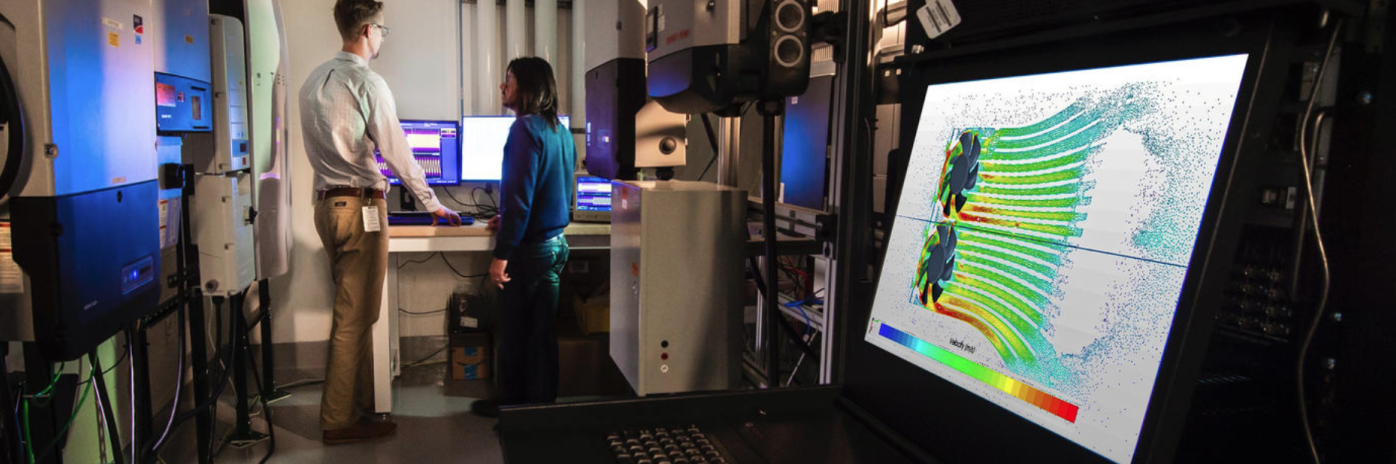
Before using simulations, the process was more complex, time-consuming and expensive. “We had to do calculations, component sizing, initial product design, prototypes and tests. If something didn’t work, we had to start all over again and test another hypothesis,” Parth recalls. Timeframes were longer, and costs increased. Now, however, we can create a highly detailed computer model (a digital twin of the actual product) and simulate various concepts and situations. For Danfoss, the model is a frequency converter (also known as an inverter or drive), i.e. a device that controls the speed of an electric motor.
“The Vacon 100-X is a drive designed by Danfoss that we optimised together. The challenge was to cool the electronics by perfecting thermal management to create a compact, reliable system,” explains Brunner. “Using simulations, together we were able to determine the optimal geometry for the cooling body to work best, what type of fan to use, and where to locate this.”
Danfoss continues to produce around 10,000 Vacon 100-X drives annually, mainly for controlling pumps, ventilators and conveyor belts, despite currently focusing on high-performance servo drives for industrial machinery, particularly bottle labelling systems in the beverage industry and robotics applications.
The decision to pursue simulation therefore proved to be a brilliantly intuitive idea. “Today’s simulators are much more reliable than they used to be. Models are increasingly more accurate, and execution speed has improved,” concludes Parth. “Another step in the development of the technology we applied concerns hardware-in-the-loop (HIL) verification systems, which allow us to reproduce hundreds of different situations in a few hours. It would take us months to achieve the same thing with a prototype, and the quality of the result would not be the same.” After all, as we all know, innovation cannot afford to waste time.