Published
10.05.2024
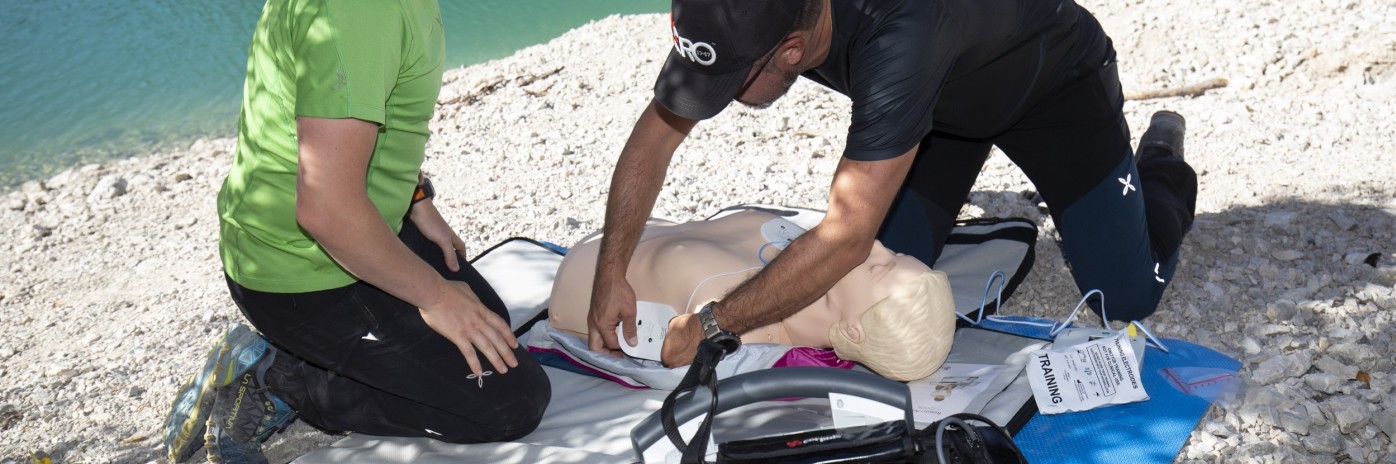
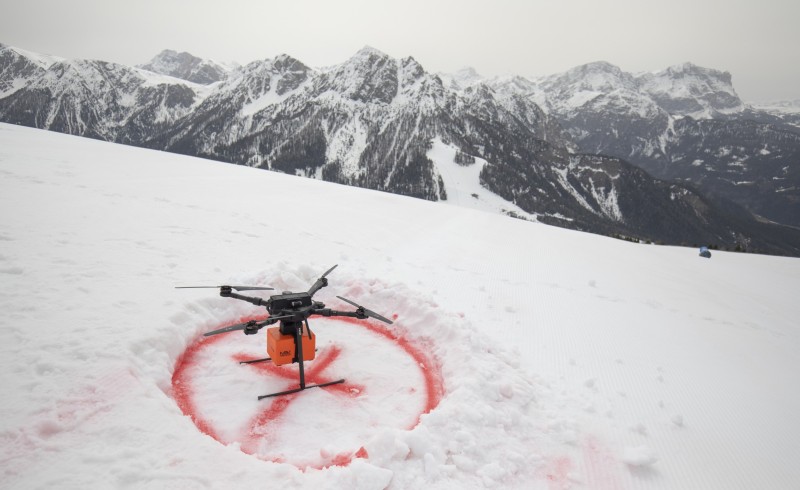
Timing is important and, in some situations, it is everything. Having a heart attack while hiking or skiing in the mountains and having to wait for emergency services is one such case. This is where DRONE-AED could make all the difference. Developed by Eurac Research’s Institute of Mountain Emergency Medicine and the Center for Sensing Solutions, in collaboration with the private company MAVTech, the project aims to evaluate and optimise the efficiency of drone use for delivering automated external defibrillators to mountain regions. The objective is to improve mountain rescue operations in the event of cardiac arrest, making them faster than conventional rescue operations, which are usually performed by helicopter or ambulance.
This ambitious, impactful project was sponsored by the Fusion Grant call for proposals organised by Fondazione Cassa di Risparmio di Bolzano and NOI Techpark, in partnership with Südtiroler Wirtschaftsring-Economia Alto Adige and Rete Economia-Wirtschaftsnetz. The call for proposals aims to support researchers under the age of 40 and to create new collaborations between research organisations and businesses. Through the project, the three partners worked closely together to design and test their idea, and then validate it in Alpine settings.
“In mountain areas, access to automated external defibrillators is usually limited, despite these being popular tourist destinations. South Tyrol is one example. By using drones, we can change the result of a cardiac emergency and increase chances of patient survival. All this with a lower environmental impact,” explains Michiel Van Veelen, a Eurac Research collaborator and emergency medicine specialist.
Drone use is linked with reduced noise and air pollution, it requires fewer people and, consequently, there is less exposure to risk, and less fuel is consumed. The research also aims to quantify the exact CO₂ savings made and compares drone use with rescue operations performed using conventional transport.
“We’ve conducted outdoor tests in Braies, on the Renon and at Corvara, and we will also be carrying out tests at Plan de Corones to assess the effectiveness of the drones are and compare them with other rescue methods, such as helicopters or ambulances,” explains Roberto Mendicino, a researcher at Eurac Research and a specialist in the development of sensor network architectures and sensor applications. Within the DRONE-AED project, Drone_AEDO has supervised indoor tests at the NOI Techpark labs and outdoor tests, as well as developing a strategy for automatically mapping supply systems using AI.
“We first tested the drones in the terraXcube, where we tested defibrillator launch – creating a special packaging for this – and flight in extreme weather conditions,” adds Gianluca Ristorto, researcher and head technician at MAVTech, which is a spin-off tech company of Politecnico di Torino at NOI Techpark and develops solutions for new aerospace technologies.
NOI Techpark was the interconnecting link for many of those involved in the project. “We’ve been working with drones for ten years, and we actively collaborate with the experts at NOI who introduced us to many of the Alpine emergency operators and MAVtech,” explains lead drone pilot at Eurac Research Abraham Mejia-Aguilar, who is well-known in his field for designing a new LoRa transmitter and receiver drone that can locate victims within a 300-metre radius (five times more powerful than conventional systems).
“We know there are still some steps before we can take this system to market, but Fusion Grant has enabled us to speed things up, create new partnerships and strengthen the process,” says Ristorto. “The implications of this project are of great importance to all the stakeholders involved, as well as to anyone involved in research. It’s a fantastic opportunity to develop our careers,” adds Mendicino. “The synergies that Fusion Grant has created are invaluable. We’re talking about a project that can literally save lives, so we all need to get involved,” concludes Van Veelen.
Complete information on the Fusion Grant call is available at: fusiongrant.info