Published
23.04.2024
“Where there’s wood planing, there’s shavings,” goes an old Italian saying. Translated into modern terms, that means: where there’s production, there’s waste. Most waste is created at the end of a product’s life cycle, unless its parts can be recycled. However, this involves separating different materials and, in most cases, results in destroying them. True remanufacturing is rare as it is labour-intensive and therefore usually not very profitable. Automated remanufacturing processes could provide a solution to this problem.
This is where a joint project between Durst and the Free University of Bolzano comes in. The project’s goal is to develop an automated remanufacturing system that saves time and labour costs. It is part of the Fusion Grant call for proposals supporting researchers under the age of 40 and building new collaborations between research organisations and local businesses. Fusion Grant is promoted by Fondazione Cassa di Risparmio di Bolzano and NOI Techpark (in partnership with Südtiroler Wirtschaftsring-Economia Alto Adige and Rete Economia-Wirtschaftsnetz).
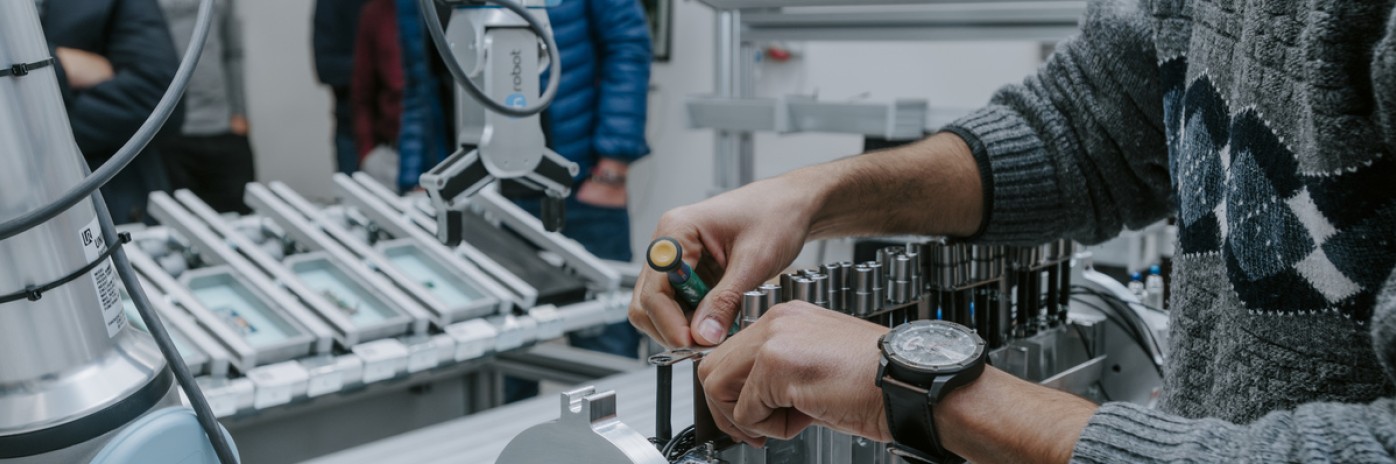
As a manufacturer of high-performance digital printers, Durst in Bressanone was the perfect fit for this research project. “Our high-quality printers contain many complex parts that deserve to be recycled,” states Markus Runggatscher, team leader of Production Engineering at Durst. For semi-automated remanufacturing, the manufacturing process must first be analysed. “The assembly unit used in the project was originally developed for manual assembly. Our goal is to redesign the unit so that a robot can carry out half the work.”
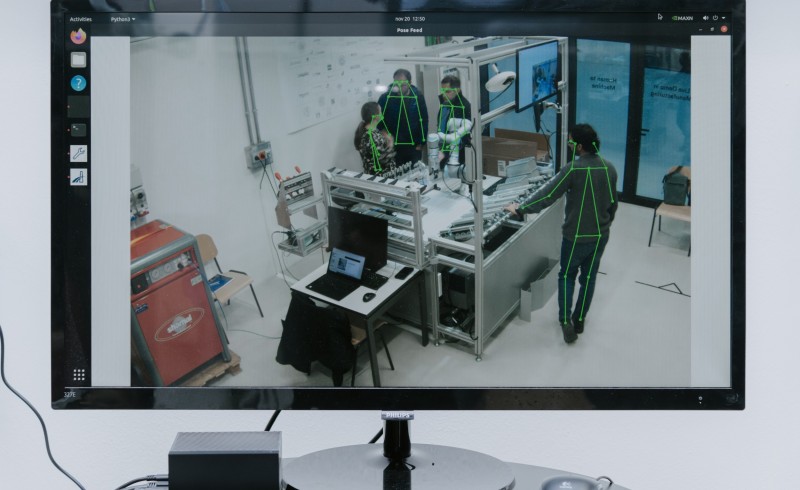
To achieve this goal, the human and the robot need to work side by side, which presents a real technical challenge. This is where AI comes in. A smart vision system tracks human movements and objects, integrating semantic task descriptions into the robot’s planning systems. This way, the system always knows which stages of work have already been completed, what needs to be done next and whether the piece that has just been assembled is in the right place.
“The problem is that the printer parts contain not only solid elements. They also contain liquid ink, as well as numerous cables and tubes, and none of that makes robot-assisted remanufacturing easy,” explains Angelika Peer, the project’s scientific coordinator and a professor at the Free University of Bozen-Bolzano, where she heads the Human-Centred Technologies and Machine Intelligence Laboratory. “However,” she adds, “the semantic descriptions of an object’s assembly process can be used to take the object apart again using the reverse sequence. This can be done by changing just one line of code.”
Seif El Islam Hasseini is in charge for robot programming. The young researcher describes the collaboration with an industry partner as particularly interesting. “Understanding industry requirements is what makes this project so exciting,” says the robotics and automation specialist.
What is certain is that Durst and unibz will continue to collaborate even after the Fusion Grant period has ended. The project has received funding from the SMACT Competence Centre, seamlessly following Fusion Grant, and the company aspires to integrate their research results into production by the end of next year.
The unibz research team would then like to extend the system to other companies and manufacturing processes. After all, the United Nations intends to significantly reduce worldwide waste by 2030 through prevention, recycling and remanufacturing. Within the European Union, manufacturers of electrical and electronic devices are already required to collect and recycle these at the end of their useful life. The Fusion Grant project by Durst and unibz is playing an important part in this.
Companies that are interested participating in the next Fusion Grant call can find all the necessary information at fusiongrant.info.
Caption: Recycling and automation are two important factors in sustainability. Combining these two offers great potential for manufacturing companies.
©NOI Techpark/Daniele Fiorentino