Alle Infos für Unternehmen auf einen Blick.



When the heating, ventilation and shading systems work together

Home automation systems are growing in popularity, but many of these still operate independently of each other. Würth and Hella have teamed up with Eurac Research on a Fusion Grant project that aims to change this by improving comfort and reducing energy consumption.
Smart home owners can automatically control heating, ventilation, air conditioning, solar shading and much more. Almost all houses are somewhat smart: the heating comes on and turns off at pre-set times each day, and the roller blinds can open and close automatically. This makes life easier and saves time. However, things would be even better if these systems could work together to provide the optimal level of comfort while saving energy and costs.
This is precisely the goal of the Fusion Grant project I-WE (Integrated Window control systEm). Fusion Grant is a call for proposals that supports researchers under the age of 40 and promotes close collaboration with local companies and research centres. It is organised by Fondazione Cassa di Risparmio di Bolzano in collaboration with NOI Techpark, Südtiroler Wirtschaftsring-Economia Alto Adige and Rete Economia-Wirtschaftsnetz.
For the I-WE project, companies Würth and HELLA are working with a research group from Eurac Research to integrate smart windows – which open and close automatically and feature motorised shading – into building control systems. This is all made possible by an intelligent algorithm that enables the central automation system to determine the best window opening setting, adjust the motorised shading system and control other systems such as artificial lighting.
This also takes meteorological data into consideration, as Robert Weitlaner, head of the InnovationLAB at Austrian solar shading manufacturer HELLA, explains. “If we know it’s going to be sunny on a winter’s day, we can take advantage of the free natural light and avoid unpleasant lighting conditions such as solar glare. This guarantees a pleasant indoor climate and reduces energy consumption from heating.”
HELLA already has an automation system for solar shading control, but Würth provides integrated control of all systems. “In collaboration with our specialist KBLUE company, we provide the brains of this test system. Our algorithm is fed by data such as indoor and outdoor temperature, solar radiation and indoor air quality – for example CO₂ content. It can use this data to automatically open windows depending on the indoor air quality and the weather conditions outdoors. This avoids unnecessary ventilation and reduces energy consumption,” explains Stefano Prosseda, head of the Würth Innovation Hub at NOI Techpark.
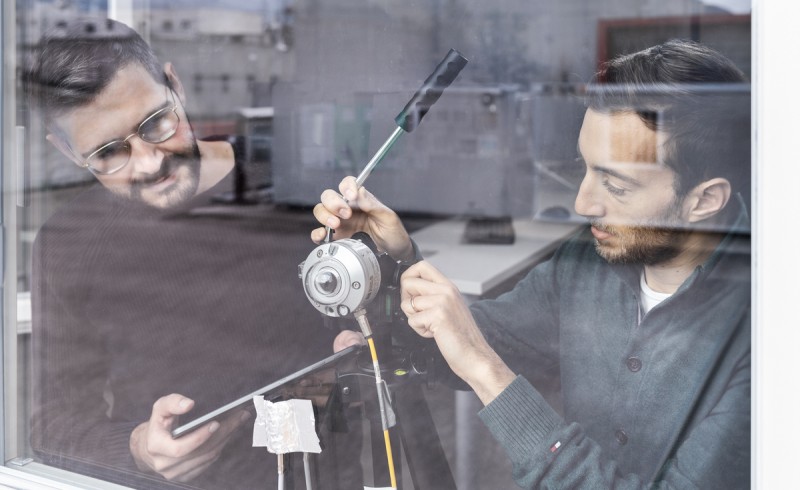
“The project is coordinated by the Institute for Renewable Energy at Eurac Research. We started with HELLA’s motorised solar shading system and Würth’s home automation system, both of which are already available on the market. Our goal was to develop a smart window tool with optimised software and hardware, and an advanced control algorithm. This uses information from connected home automation systems to determine the optimal window setting. It also exchanges information with other systems, such as heating and air conditioning, to improve their functionality,” explains Francesco Isaia, a researcher at Eurac Research’s Institute for Renewable Energy.
Currently in the testing stage, sample technology is being tested under real-world conditions at Eurac Research’s open-air lab at NOI Techpark. The system needs to be user-friendly and functional. Market analysis will be completed within the next year to determine the best way to integrate the algorithm into the final product. Until then, the system, which is designed for both new builds and renovations, will undergo testing on a series of pilot buildings.
Complete information on the Fusion Grant call is available at: fusiongrant.info.